Orofacial Myofunctional Therapy: More Than Just a Straight Smile
What if the way a child breathes, swallows, sleeps and positions their tongue could influence how their mouth and face develop?
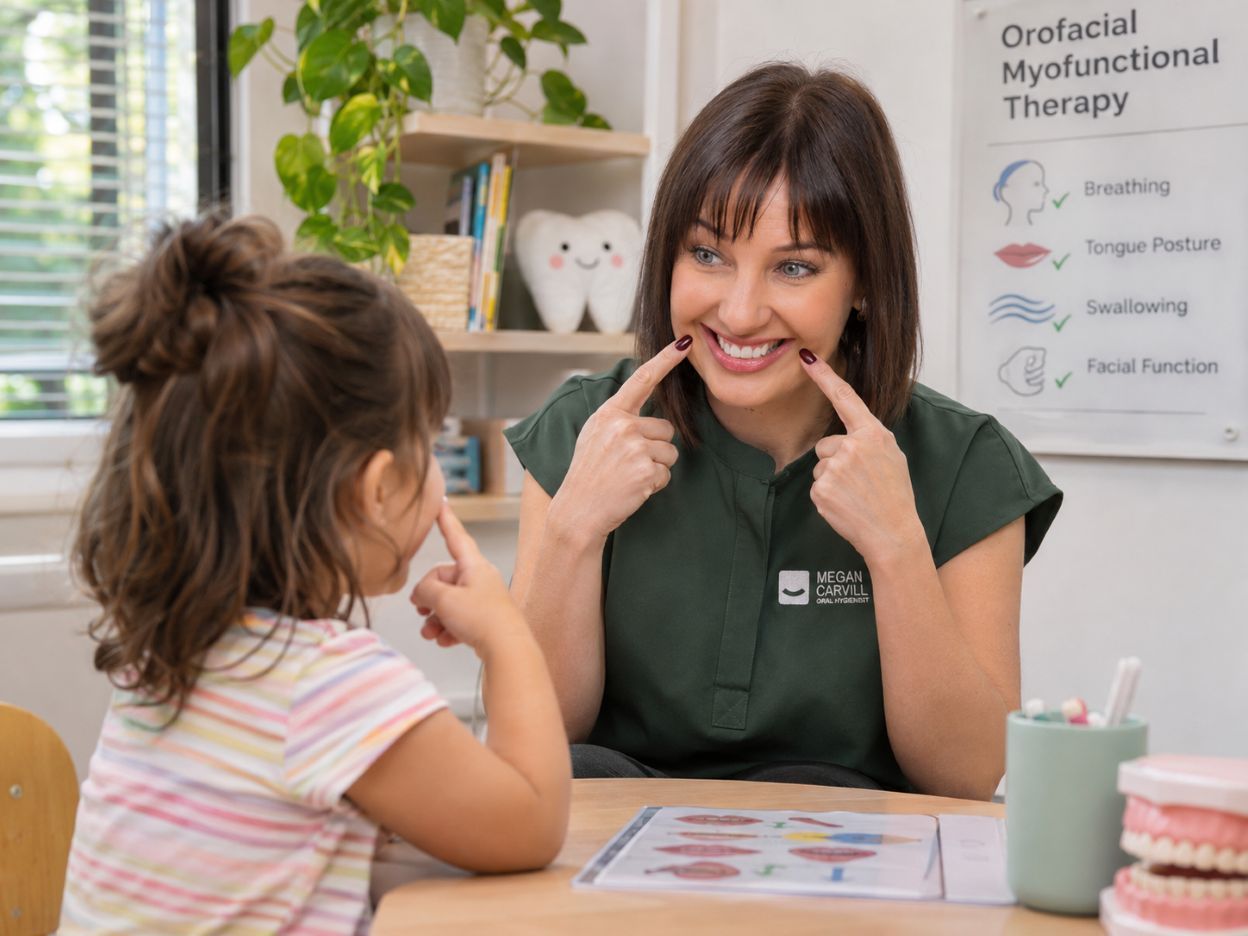
This is where Orofacial Myofunctional Therapy (OMT) comes in. OMT is still relatively new to many parents, but the basic idea is simple:
The muscles of the face, mouth, and tongue have important jobs, and how they do them matters.
OMT looks at how the tongue, lips, cheeks, jaw and breathing work together during everyday functions such as breathing, swallowing, chewing, speaking and resting. It isn’t simply about doing a few tongue exercises. It is about helping these muscles work together more efficiently so healthy function becomes the norm.
The tongue: small muscle, big job
The tongue does much more than help us taste food and speak. Ideally, when we rest, the tongue should spend much of its time against the palate (roof of the mouth), with the lips comfortably together and breathing through the nose.
This matters because we rest for hours every day. The tongue sits inside the mouth, surrounded by the lips and cheeks. These structures all influence one another as a child grows.
When the tongue rests against the palate, it provides gentle, consistent support to the developing upper jaw and dental arch. When the tongue habitually rests low in the mouth, that support is reduced while the cheeks and lips continue to apply pressure from the outside. Over time, this can contribute to a narrower upper dental arch or, in some children, a higher, narrower palate.
This doesn’t mean the tongue alone drives facial development. Genetics, skeletal growth, airway, habits and many other factors all play a role. But function is part of the picture.
What does this have to do with mouth breathing?
Humans are designed to breathe through the nose. The nose warms, filters and humidifies the air before it reaches the lungs, and nasal breathing is an important part of normal airway function. Yet many children breathe through their mouths.
COMMON DOES NOT MEAN NORMAL.
Mouth breathing is common in children, but you shouldn’t automatically dismiss it as “They’re just a mouth breather.” There may be a reason. Allergies, nasal congestion, enlarged tonsils or adenoids, structural differences, airway issues, or a learned breathing pattern can contribute.
This is why OMT should never be about simply telling a child to “close your mouth.”
If the nose isn’t functioning properly, we first need to understand why. Sometimes that means working alongside an ENT, dentist, orthodontist or another healthcare professional to identify and address the underlying factors.
What happens when mouth breathing becomes the normal pattern?
When nasal breathing isn’t happening effectively, the body adapts. The mouth may stay open, the tongue may sit lower in the mouth, the lips may become accustomed to staying apart, and the head and neck may adjust to keep the airway open. Over time, these adaptations can become the child’s normal resting posture.
During childhood, this matters because the face, jaws, and dental arches are still developing. This does not mean that every mouth-breathing child will develop crooked teeth, a narrow palate or a particular facial appearance. It simply means that healthy function is worth paying attention to while a child is growing.
So, where does OMT fit in?
OMT helps children become aware of - and develop more efficient patterns for - their oral and facial muscles. Depending on the individual child, therapy may focus on:
- Tongue posture: Helping the tongue develop an appropriate resting position.
- Lip seal: Encouraging the lips to rest together comfortably without excessive muscle strain.
- Nasal breathing: Supporting nasal breathing patterns once appropriate nasal airflow has been established.
- Strength and coordination: Improving the strength, control and coordination of the tongue, lips and cheeks.
- Chewing and swallowing: Supporting more efficient oral patterns.
- Sleep and airway-related patterns: Recognising signs that may warrant further assessment and supporting healthy oral function as part of a broader team approach.
- Oral habits: Helping children move away from habits that may interfere with healthy oral development.
But won’t orthodontics fix this?
This is an important question. Orthodontics can create beautiful and healthy dental relationships, but teeth are only one part of the picture. If the tongue, lips, and cheeks don't function well, moving the teeth doesn't necessarily change the underlying muscle pattern.
For this reason, OMT may be used before, during or after orthodontic treatment, depending on the individual. And introducing OMT early does not mean a child will never need braces. Sometimes they will.
Early intervention is not about promising to avoid orthodontics. It is about giving a developing child the best possible functional foundation and addressing contributing factors early.
We aren’t trying to predict the future.
We’re trying to give the future a better starting point.
It’s about more than straight teeth
One of the biggest misconceptions about OMT is that it is simply another way of achieving straight teeth. It isn’t.
A healthy mouth is about much more than how the teeth look.
We want children to develop into adults who can:
- Breathe comfortably through their nose
- Keep their lips comfortably together at rest
- Have an appropriate tongue resting posture
- Chew and swallow efficiently
- Use their oral muscles in a coordinated way
- Support healthy oral and airway function
Straight teeth are lovely. A functional mouth is even better.
Should every mouth-breathing child see an OMT?
Not necessarily. Mouth breathing is a symptom, not a diagnosis. The important question is:
“Why is this child breathing through their mouth?”
Sometimes you need to address a nasal or airway issue first. Sometimes the airway is clear, but mouth breathing has become a learned pattern. Sometimes several factors contribute.
That is why assessment matters.
OMT works best as part of a team approach, alongside the child’s dentist, orthodontist, ENT, or other healthcare professionals where appropriate.
Small changes. Big foundations.
Children’s faces and mouths are constantly growing and adapting.
That makes childhood an important time to identify functional patterns - not because we need to “fix” every little thing, but because small changes in function can create meaningful changes in health and development over time.
Orofacial Myofunctional Therapy helps the muscles of the mouth and face work with the growing body, rather than simply accepting an inefficient pattern because it has become normal.
Sometimes we see things every day so often that we stop questioning them. And when it comes to mouth breathing, tongue posture and oral function, it’s worth remembering:
COMMON DOESN’T ALWAYS MEAN NORMAL.
If you have concerns about your child's mouth breathing, tongue posture or oral habits, Megan Carvill offers Orofacial Myofunctional Therapy assessments in Erasmusrand, Pretoria. Contact the practice to arrange an appointment and learn more about your child's oral function.
Megan Carvill is an Oral Hygienist and qualified Orofacial Myofunctional Therapist based in Erasmusrand, Pretoria. Her approach focuses on oral health, functional habits and collaboration with other healthcare professionals when appropriate.